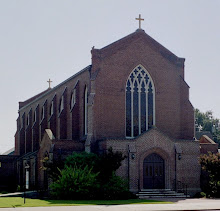
Monday, November 12, 2012

Pentecost 22: Seeing is Believing?


Jeremiah 31.7-9
Psalm 126
Hebrews 7.23-28
Mark 10.46b-52

“Seeing is believing” or so goes the old adage, but what Jesus’ disciples seem consistently to show is that seeing is not believing.  It is unfortunate that the reading from last week has been separated in the lectionary from today’s, because they are intimately connected.  They belong one to another and together reveal one of the central themes of the Gospel of Mark:  “things are not always as they seem.”  Seeing is not always believing.  Indeed, true faith in Jesus often requires of us that we see beyond our own narrow experiences and expectations.  It requires that we not allow our minds to be trapped or our hopes limited by the way we believe things are or want them to be.  While taking the present seriously it requires that our vision be able to see beyond the inherent limits and limitations of the present. 

The Christians to whom the Gospel of Mark is addressed are a community living under difficult conditions.  In Mark, the faith to which Jesus calls is not a calm, safe, self-evidently socially accepted faith, but a faith that has to struggle to maintain its existence amid opposition, incomprehension and sometimes persecution.  Written some forty years after the death and resurrection of Jesus, the Gospel begins to address the fact that Jesus’ return is not as imminent as had originally been expected.  Many who had known Jesus personally were getting old, some would have by now died.  Moreover, things weren’t even getting better, but instead were getting worse.  The Romans had even destroyed the Temple in Jerusalem, and still Jesus had not come to vindicate those who trusted in him.  It is from within this context that the author of Mark writes what is called the “little apocalypse” and says, “When you hear of wars and rumours of wars, do not be alarmed; this must take place, but the end is still to come.  For nation will rise against nation, and kingdom against kingdom; there will be earthquakes in various places; there will be famines. This is but the beginning of the birth pangs.” (Mark 13.7-8)  For Mark’s community things had not only not turned out as planned or expected, but had actually turned from bad to worse; but the author’s message is, “Hold on.  Be faithful.  Things are not always what they seem.”

Seeing, perceiving, understanding then become central themes in the Gospel of Mark.  If you remember from last week, Jesus’ followers cannot bring themselves to see the point which Jesus is making about his passion and death.  All they want it the benefits of his glory: Teacher, “grant us to sit, one at your right hand and one at your left, in your glory.” (Mark 10.37)  While seeing, they are blind to the realities of life and what it means for Jesus to be the Messiah.  This morning, however, we have quite the reverse.  It is the blind who see, and who beg to see more clearly.  It is the blind who declare the glory of Jesus, even as they are rebuked for doing so.  It is the blind who having new eyes are able to follow Jesus on the way.  It is the blind Bartimaeus who is the true disciple, and Jesus’ followers the ones who are caught up in the blindness of their expectations.

In these figures, the writer of Mark presents to his community two images of those who seek to follow Jesus.  The first represented by James, John and the other “disciples”, the second represented by Bartimaeus.  The disciples represent that first wave of the earliest Christians who, so certain of Jesus’ quick return, were already counting on their places next to him in glory.  The other, represented by Bartimaeus, is a more recent Christian community; it is a more mature Christian community.  This community has learned to recognise Jesus within and through the darkness of their times, and the seeming hopelessness of their trials and difficulties, and therefore are still able to confess him as Lord and cry, “Jesus, Son of David, have mercy on us.” (cf Mark 10.47)  We so often think of the words “Lord, have mercy’” in a penitential sense, but the fact is that in contemporary secular usage it was an acclamation used at the approach of an Emperor, comparable perhaps to “God save the Queen” or “Hail to the Chief”.  Like Bartimaeus, Mark’s community is are not asking for pity or forgiveness, but rather affirming that Jesus is the Lord, the Son of David.  Tragedy may have darkened their lives, but it has not hampered their vision or destroyed their faith  Even in the midst of their difficult situations the Good News is still good news and like Bartimaeus they hold fast to it, following Jesus on “the way.”

I see us modern-day Christians very much as the inheritors of the traditions of that later Christianity, of the Christianity symbolised by the blind Bartimaeus.  We live in a world in which the old certainties no longer exist, and one which continually offers us new uncertainties.  Our world is one in which we constantly hear of “wars and rumors of wars.”; A world in which, if we are attuned to the television, radio, newspapers we too hear of earthquakes, famines, violence, devastations.  A world in which we are all too aware of the darkness.  And Jesus does not come.  What is to be our response?  I think that it is to be the same to which the writer of Mark calls his own community:  “Be faithful.  There is more to what we see.  Do not be misled by glory, or brought to despair by darkness.  Like blind Bartimaeus continue to cry out ‘Jesus, Son of David, have mercy on us.’ ” This does not mean that we retreat from the world and let it carry on until the full revelation of Jesus.  Christianity is far more subtle than that.  Instead, it means that we can engage with the crises and darkness of our world creatively because we know that Jesus is Lord.  It means that we do not look away from the darkness to find the glory of God, but rather that we perceive the glory of God even in the darkness.  It means that we know that what we may believe to be our greatest defeats are the very places where are greatest strengths may be revealed.  Is that not, after all, the message of the cross and resurrection of Jesus?

There are none so blind as those who will not see, and even living in the presence of light is no guarantee that our eyes will be opened.  In fact, light can be as blinding as the dark, the disciples of Jesus are proof enough of that.  Thinking that they were living in the light and could clearly see, they did not look far enough or closely enough.  They had no understanding of rejection, the passion, the cross.  They were like those seeds that were sown on rocky ground, they received the Good News with joy, yet having no root, when trouble or persecution arose they immediately fell away.  They can perceive the glory of Jesus in the light, but only there.  The darkness overcomes them.  On the other hand, the community of Mark knew that if the message of God’s reconciling love and goodness was to bear fruit, they would need to perceive the glory of God and the truth of Jesus even within the darkness, even within the trials of their lives. They would need to hold on in hope and faith, and like blind Bartimaeus continually to cry “Jesus, Son of David, have mercy on us.”  They must continue to confess Jesus even when told to shut up.  Thanks to be to God that they did.

We too must continue to cry out in hope, if not literally then practically.  Whenever, we offer hope in the darkness, whenever we look for the resolution in the conflict, whenever we honestly confront the difficult (instead of shying away from it),  whenever we engage with the world as it truly is and not go into flights of fancy,  then we too cry “Jesus, Son of David, have mercy on us.  The message of Mark’s gospel is for us today.  In the darkness, “Hold fast.”  In the uncertainty, “Be hopeful.”  In all conditions of life cry out, “Jesus, Son of David, have mercy on us.”  That is the meaning of faith.  That is the meaning of living in the light which shines the darkness, and which the darkness does not overcome.

Pentecost 21: Sowing in Tears, Reaping in Joy


Isaiah 53:4-12
Psalm 91:9-16
Hebrews 5:1-10
Mark 10:35-45

Familiarity with the psalms, especially through regular recitation at the daily office, makes their verses sometimes to arise in one’s mind almost instinctively in response to other parts of Scripture or to the events in our lives.  Sometimes one particular verse will surprisingly link two seemingly disparate themes or ideas.  As we looked to celebrate the harvest here in Hanford – with its themes of celebration and thanksgiving, and as I prayed through the lessons appointed – with their own themes of suffering, difficulties and rejection, words from the 126th psalm came immediately to mind: “Those who sowed with tears will reap with songs of joy.  Those who go out weeping, carrying the seed, will come again with joy shouldering their sheaves.” (Psalm 126:6-7)  I am no farmer, but I can only imagine the intense effort involved in such an endeavor; not only its physical demands, but the worry and anxiety attendant on each planting, carrying with it as it does the real possibility of ruin should the harvest not yield the expected return.  It is not difficult to discern how in the poetic language of the psalms sowing is accompanied with tears – tears of concern and perhaps even tears of hopefulness.  Every sowing is a kind of sacrifice – sacrifice of time, labor, resources.  Bear in mind that for many in the ancient world the very seed they were sowing was potential food to live on through the spring and summer; and sowing it in the dark earth was no guarantee of a successful harvest and thus further provision.

Jesus often used the language of seed, sowing, harvest in his teaching.  He used it to highlight the nature of Christian discipleship: “Very truly, I tell you, unless a grain of wheat falls into the earth and dies, it remains just a single grain; but if it dies, it bears much fruit.” (John 12:24)   He used it to in parables to explain the subtle nature of God’s kingdom: “The kingdom of God is as if someone would scatter seed on the ground, and would sleep and rise night and day, and the seed would sprout and grow, he does not know how.  The earth produces of itself, first the stalk, then the head, then the full grain in the head.  But when the grain is ripe, at once he goes in with his sickle, because the harvest has come.” (Mark 4:26-29)  In one case, he used it to the urge his disciples to mission: “the Lord appointed seventy others and sent them on ahead of him in pairs to every town and place where he himself intended to go.  He said to them, ‘The harvest is plentiful, but the laborers are few; therefore ask the Lord of the harvest to send out laborers into his harvest.’ ” (Mark 10:1-2)  In all the instances of its use by Jesus, the language of sowing and harvest carries overt or implied resonances of sacrifice and suffering, which find their fullest expression in his own death and resurrection.  As the hymn says: “In the grave they laid him, Love whom hate had slain…laid in the earth like grain that sleeps unseen: Love is come again like wheat that springeth green.”  The writer of the letter to the Hebrews expresses this reality in these words: “In the days of his flesh, Jesus offered up prayers and supplications, with loud cries and tears….Although he was a Son, he learned obedience through what he suffered;…[and] he became the source of eternal salvation for all.” (Hebrews 5:7a, 8, 9b)

No, however much we may rejoice at the harvest – if we are fortunate to rejoice at all, the sowing is always done with sacrifice, in the midst of tears.  It requires a giving up of ourselves for the possibility of something greater than ourselves, and for the benefit of those well beyond our immediate circle.  Sowing is always a dying – whether the dying of a seed or the dying of one’s will; and always in order that the goodness – both physical and spiritual – made available by God’s grace may be more widely enjoyed.  It will not surprise you that as I go into our kitchen day by day and spend time with our Soup Kitchen volunteers, as I work with the Soup Kitchen Sub-Committee and we negotiate the difficulties and unexpected eventualities which arise in the daily progress of the kitchen’s work, I have come to see our Soup Kitchen as a field – a field in which there are many sowers laying seed in the hopes that it will yield a rich harvest in the life of others.  And while, there are perhaps no literal tears – well at least not often – there is sacrifice.  There is sacrifice of time, talent.  There is sacrifice of effort and of self, as various peoples from different places and perspectives come together for the same purpose, the hope of the kingdom’s harvest.  And increasingly I have begun to see that harvest as not simply satisfying people’s physical hunger.  The harvest we are reaping – thanks be to God – goes well beyond that.  It is also a harvest of fellowship.  Certainly, for many who visit our soup kitchen this may be the only meal they have all day; but also, it may be the only opportunity they may have to sit down with another and have a conversation, the only place they have in which to combat the hunger and poverty of loneliness.  In our volunteers I witness Christians of many denominations – Roman Catholics, Lutherans, Baptists, Episcopalians (of course) and others – Christians of many denominations setting aside the several little foibles that separate us – dying in fact to them – in order to labor and sow in the field of God’s world, in the hope of reaping the fulness of God’s kingdom. 

As Christians we should be always sowing; sowing the seeds of kindness and charity, the seeds of justice, the seeds of compassion, all in the hopes of a rich harvest: the fruition of God’s reign of kindness, charity, justice, compassion.  And, while we may not like to hear it, that sowing will and should pinch just a little, perhaps bring a few tears.  By its very nature the work of sowing those seeds will carry with it some element of sacrifice, some dying: “Very truly, I tell you, unless a grain of wheat falls into the earth and dies, it remains just a single grain; but if it dies, it bears much fruit.” (John 12:24)  We sow all sorts of seeds – today they look like canned food.  Throughout this month during our stewardship drive they look like pledge cards.  If you enter our church building and look down on the left, they look like socks.  On Halloween in Courthouse Square they’ll look like hot dogs and nachos and bags of sweets. And we sow those seeds in all sorts of ways.  Each day throughout the year it looks like people cutting vegetables, changing light bulbs, printing bulletins, laying out and mailing the Householder, washing altar linens, engaging compassionately with the stranger and the dispossessed, sharing in fellowship.  But the hope is always the same – an increase in the harvest of righteousness to the glory of God and the full manifestation of God’s kingdom.  And so, while we may indeed sow in tears, in sacrifice, we pray that we may – by God’s grace – indeed reap the harvest of his kingdom with songs of joy.  Amen.

Tuesday, October 9, 2012

Pentecost 19: "The Earth is the Lord's and All That is in It"


Proper 22
Genesis 2:18-24
Psalm 8
Hebrews 1:1-4; 2:5-12
Mark 10:2-16

 The psalm this morning speaks not only of the glory of God: “O Lord our Governor, how is exalted is your name in all the world!” (Psalms 8:1), but also of the glory of God’s creation, most specifically human beings:  “What is man that you should be mindful of him?...You have made him but little lower than the angels; you adorn him with glory and honor.” (Psalms 8:5a, 6)  It speaks too of humanity’s place within the created order: “You give him mastery over the works of your hands, you put all things under his feet: All sheep and oxen, even the wild beasts of the field, The birds of the air the fish of the sea, and whatsoever walks in the paths of the sea.” (Psalm 8:7-9)  How are we to make sense of this magnificent glory with which we have been endued, as well as the “mastery” over creation we seem to have been given?  A good rule of thumb when examining particular Biblical passages or ideas, is to use Scripture itself to interpret itself; that is, to examine other places in the biblical texts where the same or a similar idea is expressed, and allow those passages to speak to each other, as well as speak to our own context and experience. 

Today’s psalm certainly alludes to the creation narratives in Genesis.  So that’s a good place to begin.  In the first instance there is that central idea of the Judeao-Christian tradition, that human beings are made in the image and likeness of God: “Let us make humankind in our image, according to our likeness.” (Genesis 1:26a)  But there is also the idea of “dominion” over creation which needs unpacking: “Be fruitful and multiply, and fill the earth and subdue it; and have dominion over the fish of the sea and over the birds of the air and over every living thing that moves on the earth.” (Genesis 1:28)  Without going into the intricacies of the Hebrew language and the complexities of translation, it is safe to say that the Hebrew words for “subdue” and “dominion” have more subtle nuances than the English words into which they are translated would appear to suggest.  The theologian Christopher Brown paraphrases the passage in this way:  “Be fruitful and have children, filling the earth with your life so that you can have power to fight against everything in it that leads to death.  Rule with care and fairness over the natural world, over myriads of my beautiful creatures…every creature that is part of the living world.”  Certainly such a rendering is consistent with the other passages in the scriptures, most immediately in the second chapter of Genesis: “The LORD God took the man and put him in the garden of Eden to till it and to keep it.”  (Genesis 2:15)  This care for the earth finds further expression in the Mosaic law, when through Moses, God speaks to his people: “When you enter the land that I am giving you, the land shall observe a Sabbath for the LORD.  Six years shall you sow your field, and six years shall you prune your vineyard, and gather in your yield; but in the seventh year there shall be a sabbath of complete rest for the land, a sabbath for the LORD: you shall not sow your field or prune your vineyard.  You shall not reap the aftergrowth of your harvest or gather grapes of your unpruned vine: it shall be a year of complete rest for the land.” (Leviticus 25: 2b-5)  Clearly, whatever mastery or dominion we have been given does not extend to bleeding the earth dry.  The general thrust of the Scriptures is expressed succinctly in the first verse of the 24th psalm: “The earth is the LORD’s and all that is in it, the world and all who dwell therein.” (Psalm 24:1)

Human “dominion” then is one of careful and responsible tending.  You will have guessed it by now, but we are talking about stewardship.  The general thrust of scripture points to humanity’s being entrusted with stewardship of the created order.  Yet, it goes well beyond the gifts of creation.  Do you remember the parable Jesus told about the man going on  journey who entrusted his three slaves each with several amounts of money? (cf. Matthew 25:14-30)  Eventually, after a long time, the fellow came back to settle accounts with them, as the Gospel of Matthew tells us, and each was questioned as to their stewardship of the money.  It was the one who out of fear did nothing with his allotment – indeed who buried it – that was counted as irresponsible.  In fact, master goes to far as to call him a “wicked and lazy slave.” (Matthew 25:26)  Not surprisingly, this story in Matthew’s Gospel is immediately followed by Jesus’ one and only depiction of the last judgment (cf. Matthew 25:31-36) in which they are welcomed into God’s kingdom who used the resources given them for the benefit of the hungry and thirsty, the naked, the alien and the prisoner; and in which they who did not are roundly called “accursed” and sent “into the eternal fire prepared for the devil and his angels.” (Matthew 25:41)

Genuine Christian stewardship works from the premise that all things – even those things we may think we earn by our efforts, or things we “own” – are really God’s.  We are simply and graciously entrusted with their care; to use them for the good of the earth, of others and ultimately for a renewal of all things according to God’s original purposes for creation – a world of harmonious peace and equitable justice, what Jesus called the Kingdom of God.  This is stewardship at its broadest and most fundamental: responsible caretaking of absolutely everything we have been given to the glory of God for the realization of God’s kingdom.  Since as Christians we know that “the earth is the LORD’s and all that is in it, the world and all who dwell therein,” (Psalm 24:1)  then there is no part of our lives which can be considered outside the scope of stewardship – our relationships as well as our health, our homes and families, our innate gifts and abilities, the money we may earn at work, as well as the profit we may make from it.  All of it is about stewardship.

Yes, it’s all about stewardship.  As we begin our stewardship campaign at the Church of the Saviour, I hope that you will prayerfully bear this in mind, and perhaps prayerfully enter into a general stocktaking as to how you are caring for all you have been given:  When was the last time you had a physical?  When was the last time you did something to show how much you appreciate a friend or partner?  When the last time you respectfully tended your garden, or cared for an animal, whether a pet or not?  What have you done with the resources given you to make the kingdom of God a more present reality, the world a place more hospitable to the the poor, a place more equitable and just?  In thinking about our Church, are we providing adequately for its buildings as well as its mission?  Are we caring appropriately and joyfully for our services within its brick walls, and as well as our service outside them?  Stewardship is all these things, and perhaps for this reason, from the dawn creation to the day of judgement, there is in Scripture this overriding theme of stewardship and care – care for the natural world, care for our financial reources, care for others.  “The earth is the LORD’s and all that is in it, the world and all who dwell therein.” (Psalm 24:1)  Would the world know his by your actions, by our actions?

Thursday, October 4, 2012

Pentecost 18: A Welcoming Spirit Comes from a Sense of Gratitude.


Numbers 11:4-6, 10-16, 24-29
Psalm 17:7-14 
James 5:13-20
Mark 9:38-50

The Scriptures this morning resound with a self-centered sort of ingratitude.  For love of his people, God has led them out of slavery in Egypt, and delivered them from the violence of Pharaoh and his armies.  When they were thirsty in the wilderness,  “he struck the rock, the waters gushed out” (Psalm 78:20).  When they were hungry, “he rained down manna upon them to eat and gave them grain from heaven.” (Psalm 78:24)  Yet, still, as the psalmist sings, “they did not stop their craving, though the food was still in their mouths.” (Psalm 78:30): “If only,” they said,  “there were meat to eat…our strength is dried up, and there is nothing at all but this manna to look at.” (Numbers 11:4b, 6)  It’s all about me – or our little group; and Moses is no better.  God too had delivered him from the hand of Pharaoh, and even revealed God’s self to him in a distinct and particular way.  In fact, the book of Exodus tells us how “the LORD spoke with Moses, as one speaks to a friend.” (Exodus 33:11)  Yet, even he makes the present situation all about himself, as he complains to God: “Why have you treated your servant so badly?  Why have I not found favour in your sight, that you lay the burden of all this people on me?...I am not able to carry all this people alone, for they are too heavy for me.  If this is the way you are going to treat me, put me to death at once.” (Numbers 11:11, 14-15)  Now, that’s someone pretty upset just because things aren’t going his way in the immediate present.  Both Moses and the people speak from the place of “me” and “now”, which prevents them from seeing a situation bigger than themselves, and which – if it persists – will eventually keep them from moving forward, from welcoming God’s initiatives and carrying on with responding to God’s call.    

To a lesser extent, this kind of self-obsession is demonstrated also in Jesus’ disciples.  Jesus had chosen them, he had revealed to them God’s purposes and called him his friends.  However, they still made the whole thing about their private selves.  Remember how we heard last week that immediately upon Jesus sharing with them the truth of his eventual suffering and death, they entered into an argument as to which one among them was the greatest?  Today, the same sort of narrow attitude is revealed when John says to Jesus: “Teacher, we saw someone casting out demons in your name, and we tried to stop him, because he was not following us.” (Mark 9:38)  Like those of the freed Hebrew slaves and of Moses, John’s words reveal a narrow perspective fueled by ingratitude; an anger, even, propelled by a self-created sense of entitlement and privilege.

If we are honest with ourselves, there is something of this attitude in all of us; this sort of self-centered rage and myopic ingratitude which in its self-obsession often loses sight of the bigger picture.  It is this sort of attitude which can prevent us from reaching out to the other, in order to keep our circle tight.  When we cannot see or appreciate what has been good in our lives, we usually cannot be open enough to allow others in, fearful they may take the little we think we have.  When we cannot see the many generosities shown to us, we hoard.  Believing there is a limited amount of goods to go around, we rarely allow ourselves to be generous with others.  Our small “treasures” must be protected, whether those treasures are material or simply that little feeling we get from being special.  It is undoubtedly that feeling which John experiences as threatened when he comes complaining to Jesus.  He is effectively saying, “Hey look at that guy.  He’s not one of us.  Jesus, you didn’t choose him.  Where does he get off crowding in our work.”  Jesus, however – who lives constantly in generosity – answers John with most generous of responses: “Do not stop him; for no one who does a deed of power in my name will be able soon afterwards to speak evil of me.  Whoever is not against us is for us.” (9:39-40)  Jesus welcomes this stranger whom he has not even met, and approves his work.  For Jesus there will be no hoarding – whether of material goods or of a sense of being special.  He opens wide the mission of the kingdom to all, and he does this because he understands that God’s grace and generosity cannot and need not be rationed.  He does this because he has left behind any sense of his being the center of things.  It’s not ultimately about him, but about the Good News, about the mission of God’s kingdom. 

In our thinking about welcoming and hospitality, it is important to bear in mind that a welcoming spirit often comes from a sense of gratitude, from an absolute awareness of the generosity shown to us.  Only when we acknowledge – really acknowledge – the extent to which we have been welcomed, can we feel free enough to welcome others.  Only when we come genuinely to appreciate the good things we have been graciously – and most usually undeservedly – given; only then can we begin to see them as gift, and begin to make gifts of them ourselves.  It is more than simply counting our blessings – although that is part of it, but it is about shifting our perspective to encompass a wider vision which does not place ourselves at the center of things, and places our lives within a context beyond the immediate present moment.  That was the issue with the freed Hebrew slaves; they could think only of themselves and of the present moment, forgetting the covenant relationship in which they were engaged, forgetting the love and mercy shown to them, and the many gifts given them.  So, they could not welcome something new, the fullness of God’s plan for them.  John the disciple feel into a similar trap; so keen of the narrow limits he imagines surrounding Jesus and his mission, he is not willing to welcome someone whose vision is the same, albeit who is outside the “circle”, as it were.

I would suggest, that the extent to whish we are grateful, and live in awareness of the generosities shown to us, is the extent to which we are willing to stand in a posture of welcoming, whether welcoming new situations or new people.  In the last few weeks we have looked at issues surrounding welcoming and hospitality: their transforming nature, the sacrifice and humility they will require of us.  However, at its foundation the very desire to go out from ourselves into the unknown, and to those unknown, comes from a place of deep and abiding gratitude, from an abiding awareness of the many good things given to us, of an experienced encounter with grace.  We do not need to hoard the things we have because we recognize them ultimately all as given.  So, when the stranger comes we can share.  We do not have to hold a tight rein around a feeling of being special or chosen, because we know and celebrate that we are special and chosen, and we long for others to know and celebrate that too about themselves.  We do not have to make ourselves the center of things, fearing that if we don’t look out for ourselves no one will.  Rather we can welcome everyone and care for others without fear, knowing that ultimately we will lose nothing of ourselves.  This, in part, is what Jesus means, when he tells his followers, “Those who try to make their life secure will lose it, but those who lose their life will keep it.” (Luke 17:33)  In short, gratitude and an awareness of the generosity shown to us, free us to let go in all kinds of ways.  They free us from the fears attendant on ingratitude and self-centeredness which prevent us from opening wide our arms, and then seeing beyond them to the new, to the other, to the stranger, to the surprising. 

Dag Hammarskjöld was a Swedish diplomat, economist, and author, as well as Secretary-General of the United Nations in the middle of the last century.  President Kennedy called him “the greatest statesman of our century”.  In his published reflections entitled Markings, he wrote: “For all that has been, thanks. For all that will be, yes.”  Nowhere have I found a more pithy encapsulation of the gratitude and welcome to which the Gospel calls us.  It challenges us to respond in gratitude to the events of our lives, while widening the circle of lives to welcome the in trust the unknown, both people and events; and it leaves with the probing question:  “How seriously do we take God’s generosity in our lives, and how willing are we to step outside of ourselves and the immediate to welcome the new and the other – the new future, the strange, the surprising, even the strange?”